
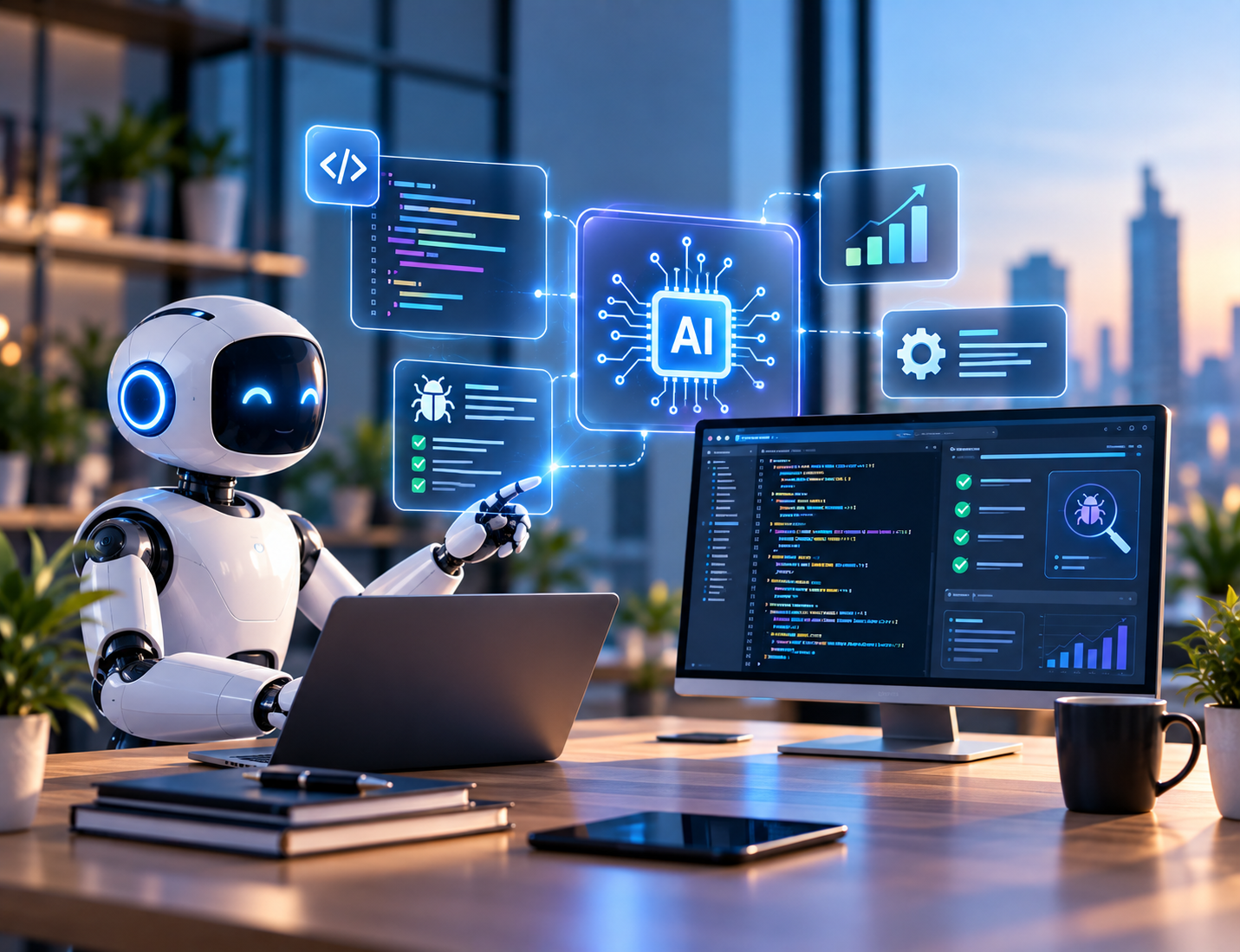
How AI Is Changing the Role of Software Testers & Developers
How AI Is Changing The Role Of Software Testers & Developers
Introduction To AI Software Development
Artificial Intelligence (AI) technology has a profound impact on software development, enabling the automation of tasks, enhancing code quality, and reducing the time it takes to bring software into production. Previously a distant possibility, AI is now a critical capability in modern software engineering, from code generation and bug detection to intelligent testing and predictive regression testing.
As there continues to be widespread demand to create and deliver solutions more efficiently, rapidly, and at scale, there is a growing need to incorporate AI in development workflows. AI's unique capability to learn, adapt, and optimize processes is going to be the game-changer in development. With more AI-driven tools on the market, developers and testers should be able to devote their time to innovation and leave the tedious and time-consuming tasks to machines, which makes AI tools more pertinent and necessary now than ever before.
AI-Powered Development Tools
AI-infused coding solutions like GitHub Copilot and Amazon CodeWhisperer are changing how developers write code. They use machine learning to present judicious code proposals, supported with real-time autocompletion, and can generate complete functions based on simple prompts. By detecting and correcting bugs in real-time, they save valuable debugging time and improve the quality of code.
For experienced developers, the assistance increases productivity by automating mundane tasks and shortening the development cycle. For new developers, AI-driven coding tools are interactive learning tools in the sense that they provide real-time examples as well as guidance that help to learn syntax and logic concepts much quicker. Although they help programmers in recognizing suggestions from "GPT" or "Copilot," the experience for programmers adds some complexity because developers have to arrive, on their own, at the decision to trust the suggestions produced by AI and how to validate those produced results.
AI-augmented coding tools are transforming software engineering by blending code with intelligence assistance, thereby speeding up development, leading to better accuracy, and making programming more accessible and understandable to more people with different skill levels.
AI In Software Testing
Automated Test Case Generation: AI tools review code and user actions to automatically create valid and efficient test cases, saving time on manual tasks.
Predictive Bug Detection: Machine learning models classify details about bugs, identifying patterns from past bugs to predict and prevent further issues while the code is in development.
Risk Assessment: AI can review a codebase and identify the risk areas that concern testers in order to prioritize higher-impact test scenarios.
AI-Powered Regression Testing: Quickly identify the impact of code changes and run tests to ensure stability testing by only selecting and running the tests relevant to the code change.
Performance and Security Testing: AI can evaluate simulated patterns of real-world usage to efficiently identify performance bottlenecks and potential security flaws.
Shift In Skillsets
The growth of AI in software development means that skill sets are going to change substantially. The movement is away from the basic repetitive manual tasks and more toward strategic and analytical functions. From a developer and tester's perspective, it is increasingly important to understand not just AI/ML concepts, but also the different types of algorithms and tools. Furthermore, while automation and AI can execute certain tasks related to interpretive data, training data, and decision-making, domain expertise is needed now more than ever so that AI solutions can operate effectively in their environment. As a result, developers must have this multifaceted domain knowledge, along with analytical thinking and business knowledge, so that they can recognize and leverage the value of human-oriented skills to facilitate and enhance AI-driven development activities.
Collaborative Human AI Workflow
Collaborative Human-AI workflows are revolutionizing software development because they enhance developers' and testers' abilities without replacing them. The AI can perform repetitive and data-heavy tasks such as test case generation, bug triaging or helping to suggest code. This frees up developers and testers to focus on higher-order thinking, complex logic, creativity, and other human areas such as ethical standards, contextualized judgment, and quality assurance.
Take, for example, the article of a code completion AI; it may offer code fixes, but a developer makes the call about relevance, or an AI may point out a performance problem, but then the tester will explore this in detail. Together, they create productivity and lower error rates, and achieve a faster delivery, surpassing human intuition and control over crucial aspects of software design and testing.
Challenges And Ethical Considerations
Trust and transparency: To instill trust and accountability, developers need a clear understanding of how the AI crafters' suggestions are made.
Bias in the outputs of AI: There are many instances of bias in AI that will be reflected in the models' training data, causing erroneous code, test results, or unfair outcomes.
Data privacy: When AI tools using sensitive or proprietary data are trained or fine-tuned, there is a risk of exposing user privacy and potential violations of laws and regulations.
The ownership of AI-generated code and the unintentional reuse of copyrighted content raises ownership questions.
Over-reliance on AI: Trusting AI decision-making may lead developers to abandon human oversight, increasing the potential for errors that might be considered fatal.
Future Outlook
Continuously Evolving Job Roles: Emergence of new specialized roles such as AI auditors, ML Ops engineers, and test engineers who will focus on AI/ML systems.
AI as part of the DevOps Process: Seamlessly integrating AI tools into DevOps pipelines to automate monitoring, testing, and deployments.
AI as Co-Developer:
As a result of AI-assisted coding tools available to create, optimize, and review code in real time, the reliance on AI will increase.
AI as Co-Tester:
AI will provide an added testing framework that will identify anomalies, predict bugs, and assist with quality in large-scale systems.
Upskilling for Professionals: Professionals will need to develop workflows balancing classical skills with AI skills.
Conclusion
AI is changing the game for software development with improved efficiency, better accuracy, and more innovation. As roles change and develop into possibilities, it is now time to take ownership of adaptability and commit to continuous learning. Professionals must stay informed with AI trends and tools to succeed, seemingly, whilst harnessing the true potential of AI-human collaboration in the software development process moving into the future.